
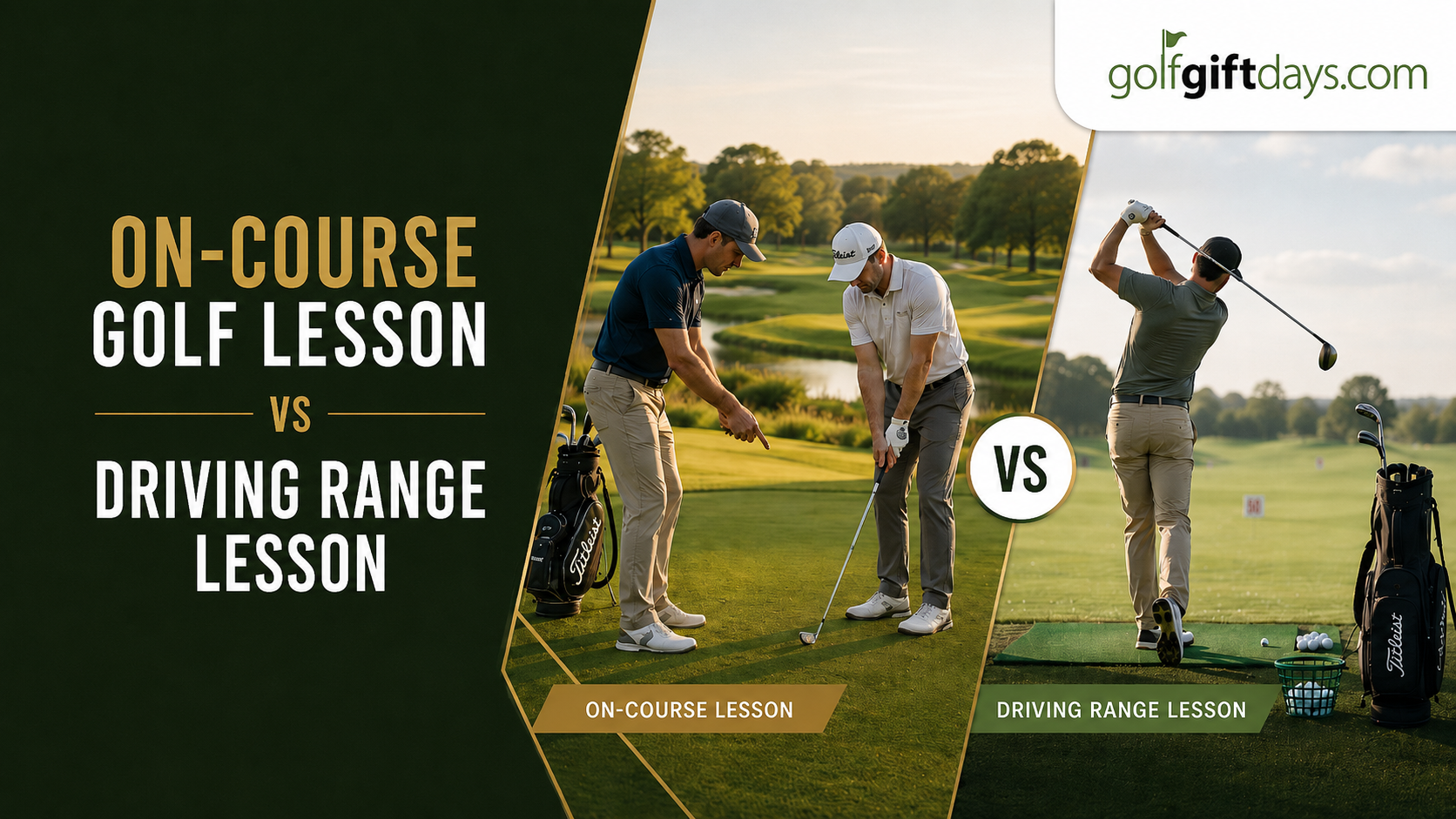
Introduction
An on course golf lesson and a driving range lesson solve different problems and golfers often book the wrong one first. Both have their place. Neither is the better option in every situation. What matters is what’s actually going wrong with your golf.
A range lesson strips everything back to the swing itself. An on-course lesson puts that swing under pressure with real lies, real decisions and an actual scorecard that doesn’t care how pretty your swing was in practice. Once you know what you need to work on, choosing between the two becomes much simpler.
On-Course vs Driving Range Lesson: Key Differences
| Area | Driving Range Lesson | On-Course Golf Lesson |
| Environment | Controlled setting with fixed targets | Real playing conditions that change every shot |
| Main focus | Swing mechanics and ball striking | Decision-making and scoring strategy |
| Repetition | Same shot repeated for consistency | Every shot is different |
| Feedback | Immediate technical correction | Context-based advice during play |
| Typical work | Grip, posture, swing path, contact | Club choice, targets, course management |
| Pressure | Low-pressure practice environment | Real round pressure and consequences |
| Best for | Beginners and swing changes | Beginners and golfers fixing one fault |
When Is an On-Course Golf Lesson the Better Choice?
On-course instruction is ideal for someone who has decent mechanics but is still frustrated with his or her results.
Good course play starts with using the shape and distance you actually have that day, not the shot you hope to produce.
When Your Range Game Does Not Transfer to the Course
One of the most common frustrations among golfers is “I hit it well on the range, but I cannot do it on the course.”
This happens because the range removes many of the challenges that make golf difficult.
On the course, you have to deal with:
- Different lies
- Trees and hazards
- Wind direction
- Uneven ground
- Changing distances
- Pressure over important shots
During an on-course lesson, a PGA professional can see whether your practice swing actually works when you have to choose a target and commit to a shot.
When Course Management Is Costing You Shots
Course management is mainly about avoiding unnecessary trouble.
A golfer may attack a tucked flag from a poor angle or take a long club from thick rough. In both cases, the costly mistake happens before the swing.
During an on course golf lesson, the professional may help you answer the following:
- Where is the safest side of the fairway?
- Which club removes the biggest danger?
- Is the flag worth attacking?
- Where can you miss and still have a simple next shot?
- Should you lay up or carry the hazard?
- What is a sensible target after a poor tee shot?
When You Need Help in Real Playing Conditions
A flat practice area cannot copy every situation found during a round.
On the course, you may need help with:
- The ball above or below your feet
- Uphill and downhill lies
- Light or heavy rough
- Wind direction
- Firm or soft ground
- Bunker carries
- Recovery shots with limited space
You learn how the lie may affect the shot, how much risk is sensible and which club gives you the best chance of returning the ball to play.
When Is a Driving Range Lesson the Better Choice?
Choose a driving range lesson when you need to build or repair a repeatable movement. The professional can watch several shots, suggest a change and check the result straight away.
When You Are New to Golf
A complete beginner normally benefits from starting on the range.
A range lesson lets you learn the basics without also worrying about hazards, pace of play and scoring.
Early coaching may cover:
- How to hold the club
- A comfortable stance
- Ball position
- A simple swinging motion
- Making clean contact
- Aiming safely
When You Need to Correct a Swing Problem
The range is usually the better place for a repeated technical fault. The professional needs to see a repeated miss several times before deciding what is causing it.
A focused lesson may work on:
- Grip pressure or hand position
- Alignment
- Ball position
- Balance
- Clubface control
- Strike location
- A shorter practice movement
You can make the change slowly, receive feedback and try again without each shot having a different purpose.
When You Want to Focus on One Part of Your Game
A range lesson also works well when your goal is specific.
You may want to straighten the driver, improve iron contact or control wedge distances. The professional can keep the session on that single area.
Arrive ready to explain:
- What the bad shot looks like
- Which clubs are affected
- When it appears during a round
- Whether pressure makes it worse
- What you have already tried
The more clearly you describe the problem, the less time the lesson spends trying to work out what you want to change.
What Happens During an On-Course Golf Lesson?
The session normally begins with a short discussion about your game, recent scores and the shots that cause trouble. The professional then watches you play rather than stopping every swing.
Feedback may cover:
- Your plan from the tee
- Club choice and target
- Pre-shot routine
- Alignment
- Decisions from poor lies
- Approach-shot strategy
- Chipping and pitching choices
- Putting pace and green reading
- Your response after mistakes
What Happens During a Driving Range Lesson?
A range lesson starts with a discussion of the problem and enough shots for the professional to see a pattern.
The session usually follows a simple process:
- The professional checks setup, movement, strike and ball flight.
- The main issue is explained clearly.
- You try one correction or drill.
- You finish with a practice point for your next range visit.
You should leave knowing what to practise and what a better shot should look or feel like. A new movement can feel awkward, so judge the lesson by whether the change makes sense and can be rehearsed alone.
Conclusion
The on-course vs driving range lesson decision depends on where your shots are being lost.
Choose the range when you are new to golf, need repeated technical work or want to concentrate on one club. Choose an on-course golf lesson when your swing is serviceable but your scoring, decisions or confidence break down during a round.
Many golfers eventually need both. The range helps build the shot. The course teaches you when to use it, where to aim